
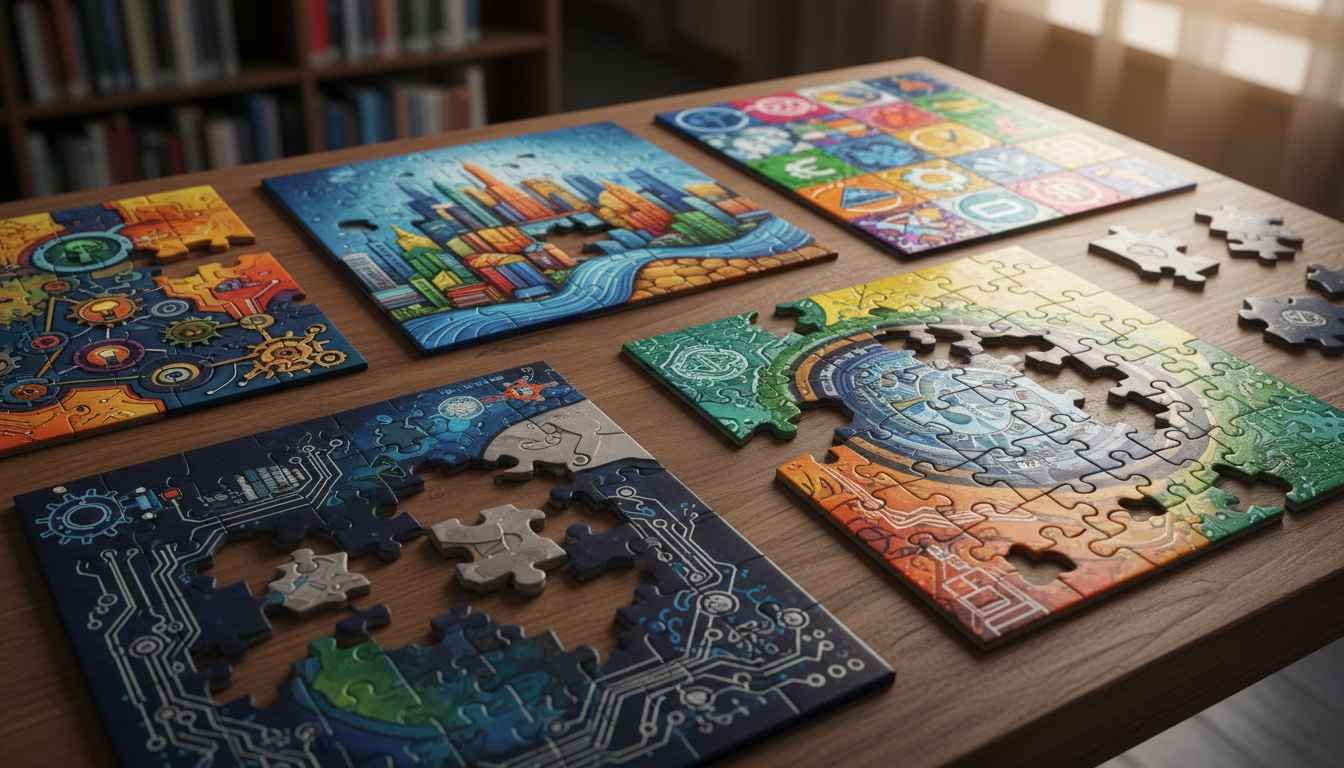
The Rising Urgency to Strengthen Adult Learning Retention
In today’s accelerated digital world, the demand for effective adult education programs is soaring like never before. Yet, the real challenge isn’t just teaching – it’s making knowledge stick. Adult learners often juggle multiple priorities – careers, families, and financial obligations – leaving them vulnerable to forgetting what they’ve learned almost as soon as the course ends. The pressure to retain new information is intense, and this is where innovative tools like educa puzzles come into play. These brain-stimulating experiences fuse learning with engagement, giving learners a tangible way to connect abstract concepts to real-life scenarios. Imagine a corporate training program where participants don’t just read policies but solve interactive, puzzle-like challenges that anchor the lessons in memory. The modern adult education ecosystem demands these kinds of experiential strategies, and failing to adopt them can mean falling behind competitors who are already integrating such cognitive reinforcements. The clock is ticking – institutions that fail to upgrade their learning retention strategies risk losing relevance and credibility in an education landscape that rewards adaptability and innovation.
Why Traditional Memory Techniques Are No Longer Enough
Gone are the days when flashcards and rote repetition were enough to help adult learners retain knowledge. The human brain craves stimulation, novelty, and emotional connection, none of which are found in outdated memorization drills. Neuroscientists confirm that retention increases dramatically when learners experience moments of challenge, reflection, and reward. That’s why the introduction of gamified experiences, especially educa puzzles, is transforming how adults learn. Unlike static lessons, these interactive puzzles engage visual, auditory, and kinesthetic learning channels, creating multisensory reinforcement loops that make recall almost effortless. Consider an adult learner mastering financial literacy: when they manipulate puzzle pieces representing investments, returns, and risks, they’re not just reading – they’re experiencing. This active participation locks the knowledge deep into their long-term memory. As adult learning programs continue to evolve, institutions that ignore these developments risk becoming obsolete. The urgency is palpable; traditional memory tools can’t compete with dynamic, immersive learning environments that feed curiosity and reward engagement.
Engaging Emotions and the Science of Recall
Emotional engagement is the heartbeat of lasting memory. Research consistently shows that people remember what makes them feel something – whether it’s excitement, curiosity, or even mild frustration during problem-solving. Adult learners thrive when educational content triggers these emotional responses, and that’s precisely what educa puzzles deliver. They turn passive information into emotional experiences, allowing learners to connect feelings with facts. Imagine the sensation of solving a complex puzzle that mirrors real-world challenges – each solved piece reinforces confidence, anchoring the lesson into emotional memory. This deep, emotional learning is especially critical in adult education, where motivation often stems from personal or professional necessity. By designing programs that harness emotion through interactivity, educators tap into the limbic system – the part of the brain responsible for memory consolidation. This isn’t just theory; global learning platforms report retention boosts of up to 65% when emotional engagement strategies like gamification and puzzle-based learning are integrated. The race to adopt these emotionally intelligent learning models is on, and those who hesitate risk being left behind as others master the art of recall through meaningful emotion-driven education.
The Power of Cognitive Load Management
Every adult learner faces the same challenge: too much information, too little time. Managing cognitive load is the key to ensuring that knowledge doesn’t just pass through the brain but takes root. Here’s where educa puzzles stand out – they break complex concepts into manageable, visual tasks that prevent overload. Instead of overwhelming the learner with dense text or endless slides, these puzzles present bite-sized challenges that maintain attention and build mastery step by step. It’s the educational equivalent of climbing a mountain by following clear, well-marked trails instead of scaling a sheer cliff. By chunking information into interactive components, adult education programs can drastically reduce dropout rates and improve confidence. Cognitive science supports this approach: when learners actively organize and manipulate knowledge, their retention capacity multiplies. The urgency is undeniable – educational institutions that cling to old lecture-based models are hemorrhaging engagement and outcomes. The shift to structured, cognitively balanced learning powered by educa puzzles isn’t optional anymore; it’s the new baseline for effective adult education in an age of endless distraction.
Gamification as a Catalyst for Retention
The fusion of education and play has proven to be one of the most powerful catalysts for memory retention. Gamification transforms dull, static lessons into immersive experiences that feel like quests, not chores. In adult education, the stakes are higher – learners demand efficiency, relevance, and reward for their time. Educa puzzles capitalize on this by merging problem-solving with progress tracking, creating a dopamine-driven loop that keeps learners hooked. Each completed puzzle level or challenge triggers the brain’s reward center, embedding knowledge through pleasure and achievement. Picture a training program on cybersecurity where learners “defend” systems by solving digital puzzles that mirror real attacks – suddenly, abstract concepts become thrilling missions. Studies from leading learning analytics firms confirm that gamified programs can boost retention rates by over 80% compared to traditional e-learning. This isn’t a future trend – it’s happening now, and organizations that don’t gamify their adult learning experiences will soon find themselves invisible in a crowded market where engagement equals survival. The FOMO is real: learners are flocking to programs that challenge, entertain, and reward them at every step.
Integrating Technology and AI for Personalized Learning Recall
Artificial Intelligence is rewriting the rules of education, especially when combined with interactive learning tools like educa puzzles. AI algorithms can now track each learner’s performance, detect patterns in their problem-solving, and adjust challenges in real time. This level of personalization ensures that no learner is left behind, and every engagement becomes an opportunity for tailored growth. Picture a virtual tutor that recognizes when you’re struggling with a concept and instantly presents a puzzle designed to reinforce that specific area – this is not science fiction; it’s the new frontier of adult learning. Data-backed personalization ensures maximum retention because the learning experience adapts dynamically to the learner’s needs. Corporate training departments are already using AI-driven puzzle modules to enhance onboarding efficiency, reduce time-to-competence, and verify comprehension through performance metrics. The integration of these technologies is a trust signal for learners – they know that such programs are backed by advanced analytics, verified content, and responsive support. Missing out on this innovation means missing out on the very tools redefining competitive learning in 2025 and beyond.
Building Real-World Relevance Through Experiential Design
Adult learners crave relevance; they want to know that what they learn today can be applied tomorrow. Experiential learning design bridges that gap by transforming lessons into real-world simulations. With educa puzzles, theory transforms into tactile, visual experience. For instance, a leadership course could integrate puzzles that simulate crisis management, decision-making, or negotiation scenarios. Each move mirrors real consequences, allowing learners to test strategies without risk. This hands-on approach cements recall because it connects knowledge to action – a cornerstone of adult learning theory. Educators who’ve adopted experiential puzzle-based learning report higher course completion rates, improved learner satisfaction, and measurable skill transfer to the workplace. The urgency here is unmistakable: learners no longer tolerate disconnected theories or bland lectures. They demand relevance, responsiveness, and realism. Programs that fail to deliver this lose credibility overnight. The power of educa puzzles lies in their ability to make learning not just memorable but deeply applicable – a must-have in the era of outcome-driven education.
Trust, Security, and Verified Results in Modern Learning Platforms
Trust has become the currency of online education. Adult learners invest not only their money but their hopes for advancement, making it essential that learning platforms demonstrate transparency, security, and proven outcomes. Programs that incorporate educa puzzles are gaining an edge because they provide measurable results through verifiable performance data. When learners can see their progress quantified – how many puzzles solved, how concepts improved over time – it fosters confidence in the program’s credibility. Moreover, leading platforms offering puzzle-based learning use licensed content, encrypted data systems, and certified instructors to ensure every learner’s privacy and security. Verified payouts for corporate training ROI, responsive customer service, and adherence to global education standards like ISO/IEC compliance all contribute to building institutional trust. In this climate of digital saturation, learners are increasingly skeptical of unverified sources. Adopting secure, data-backed tools such as Educa Puzzles signals that an institution is not just teaching but protecting and empowering its learners. The urgency here cannot be overstated: credibility is king, and learners gravitate toward platforms that offer both innovation and integrity.
Actionable Strategies to Boost Retention Now
The time to act is now. Organizations and educators that implement retention-boosting techniques are gaining measurable advantages in learner satisfaction, engagement, and long-term outcomes. Begin by blending visual storytelling with interactive puzzles to stimulate multiple memory pathways. Incorporate consistent feedback loops where learners immediately apply what they learn in challenge-based modules. Leverage educa puzzles to anchor complex concepts in the learner’s mind, ensuring recall under pressure. Train facilitators to use data analytics to identify weak retention areas and deploy targeted puzzle-based interventions. Don’t wait for a quarterly review – start testing, adjusting, and scaling your programs today. Every day of delay means another learner who disengages, forgets, or drops out. The FOMO here is real: competitors are already enhancing their adult education programs with retention-driven design, and their success stories are attracting attention across industries. Institutions that embrace this transformation early will set the standard for excellence in adult learning. Those who hesitate will find themselves chasing the leaders who understood that engagement and recall aren’t luxuries – they’re the new essentials.
Conclusion: The Future Belongs to Adaptive, Engaging Learning
The evolution of adult education is accelerating faster than ever. Static lectures and repetitive tests are relics of a past that no longer meets the demands of modern learners. The combination of interactivity, emotional engagement, cognitive balance, and verified trust systems defines the new learning frontier. Educa puzzles encapsulate all of these strengths, offering educators and learners a powerful, evidence-backed way to ensure retention and recall. The sense of urgency cannot be overstated – those who act now to modernize their programs with these innovative tools will command authority, trust, and measurable success. Every puzzle solved is a lesson remembered, a skill refined, and a learner empowered. Don’t watch from the sidelines while others transform their educational outcomes. Take the lead, implement puzzle-based retention strategies, and witness how adult education evolves into an experience learners crave rather than endure. The future of retention isn’t passive – it’s active, immersive, and waiting for you to seize it today.
If you want to transform your approach to learning, consider exploring quad education reviews to identify effective strategies that can enhance both personal and professional growth.
